
BMW vehicles are known for their handling, precision, and performance. But when temperatures drop and road conditions change, even the most advanced BMW needs the right tires to maintain traction and control.
One of the most common questions BMW owners ask is whether their xDrive all-wheel-drive system is enough for winter driving. Others wonder whether their BMW M car, equipped with high-performance summer tires, is suitable for Vancouver’s relatively mild winters.
The answer depends on your tires, driving conditions, and where you travel.
In British Columbia, winter tire requirements apply to many designated highways starting October 1. While winter tires may not be legally required for every trip around Richmond or Vancouver, having the right tires can make a significant difference in wet, cold, snowy, and icy conditions.
At CG Motorsports in Richmond, BC, we specialize in BMW maintenance, diagnostics, and performance vehicles, including BMW M cars and xDrive models.
If you drive your BMW year-round, understanding how tires affect winter performance is an important part of keeping your vehicle safe and enjoyable to drive.
What Are BC's Winter Tire Requirements?
British Columbia requires qualifying winter tires on many designated highways between October 1 and March 31, with requirements extending to April 30 on certain routes.
For passenger vehicles, tires must meet the following minimum requirements:
- Display the M+S (Mud and Snow) marking or the three-peaked mountain and snowflake symbol
- Have at least 3.5 mm of tread depth
- Be installed in accordance with provincial requirements, including on all four wheels for passenger vehicles
Both M+S and mountain snowflake tires meet BC’s minimum legal definition of winter tires, but they do not necessarily provide the same performance in severe winter conditions.
A tire may be legally acceptable yet still offer less winter traction than a dedicated winter tire.
For BMW owners who regularly travel to Whistler, the Interior, or mountain highways, tire selection deserves particular attention.
Check the latest designated routes and requirements on the Government of BC winter tire website.
Does BMW xDrive Still Need Winter Tires?
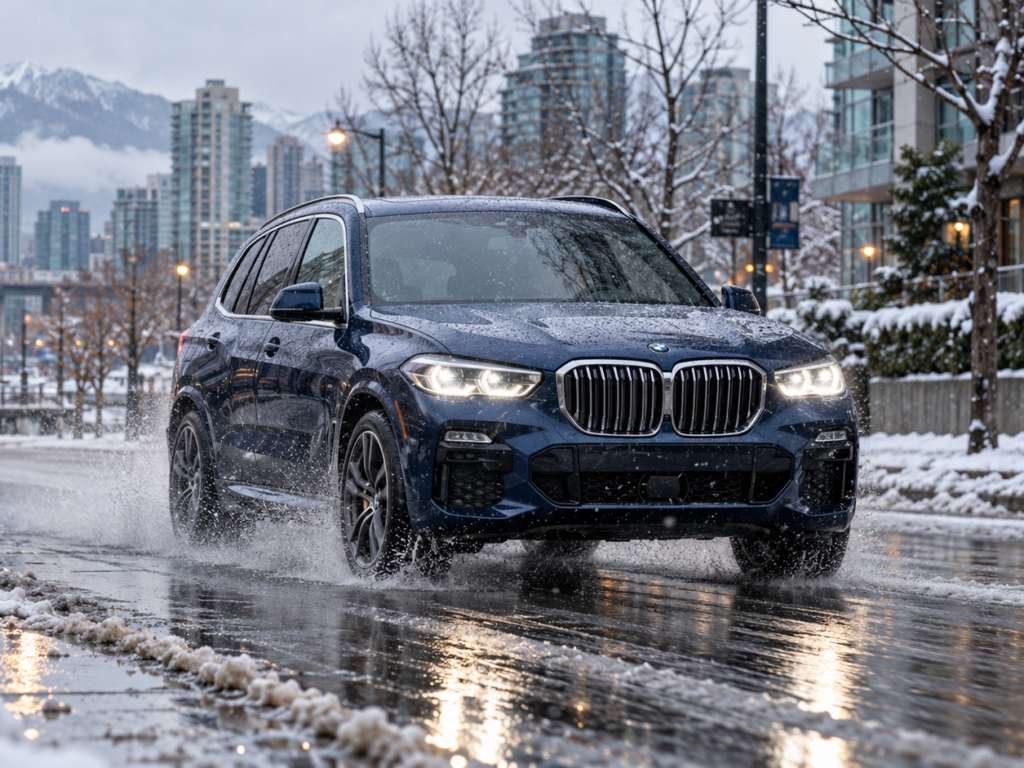
Yes. BMW xDrive can improve traction when accelerating, but it cannot replace the grip provided by proper winter tires.
BMW’s xDrive system automatically distributes power between the front and rear wheels to help maintain traction and stability.
This can be particularly useful when accelerating on slippery roads or navigating changing driving conditions.
However, all-wheel drive does not automatically improve tire grip when braking or cornering.
Your BMW still depends on the tires to maintain contact with the road.
Consider the following:
- Acceleration: xDrive can help distribute power to wheels with available traction.
- Braking: Winter tire grip is critical to stopping performance, regardless of whether your BMW is rear-wheel drive or all-wheel drive.
- Cornering: Tire traction influences how effectively your BMW maintains control through turns.
- Snow and ice: Even an xDrive-equipped BMW can lose traction if its tires are not suitable for the conditions.
A rear-wheel-drive BMW equipped with quality winter tires may perform better in certain winter braking and cornering situations than an xDrive BMW running inappropriate summer tires.
The bottom line: xDrive is an advantage, but the correct tires remain essential for winter driving.
Are BMW M Performance Cars Suitable for Winter Driving?
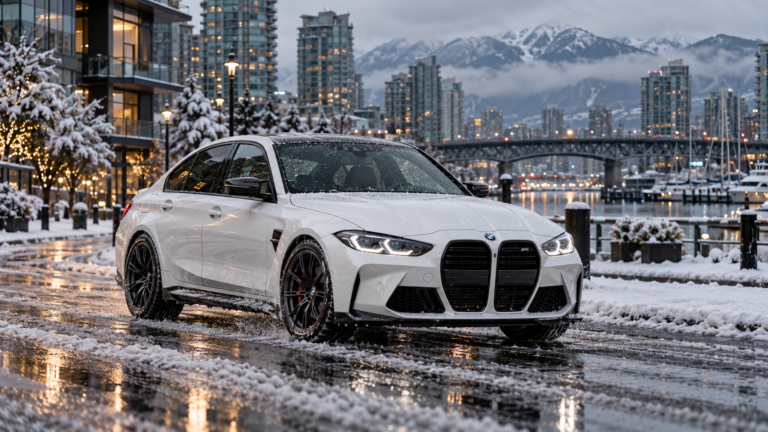
BMW M vehicles are engineered for performance, responsive handling, and precise control.
Models such as the BMW M2, M3, M4, and M5 often come equipped with high-performance summer tires designed to maximize traction in warmer conditions.
These tires perform exceptionally well on dry pavement and during spirited driving, but they are not designed for snow, ice, or freezing temperatures.
As temperatures drop, summer tire compounds can become less flexible, reducing their ability to maintain grip.
This is especially important for BMW M owners because of the vehicles’ high power output, responsive steering, and performance-oriented suspension setups.
If you drive your BMW M car during winter, consider:
- Switching to winter tires before freezing temperatures arrive
- Using BMW-approved winter wheel and tire sizes
- Checking tire load and speed ratings
- Maintaining appropriate tire pressures
- Inspecting tread depth and overall tire condition
Some ultra-high-performance summer tires also have manufacturer restrictions regarding storage or use in freezing temperatures, so it is important to follow the specific tire manufacturer’s recommendations.
For BMW M owners who enjoy summer track days or performance driving, having a separate winter wheel and tire setup can help preserve summer tire performance while providing better traction during colder months
BMW Winter Tires vs. All-Weather Tires: Which Is Better?
Not every BMW owner needs the same winter tire setup.
For drivers who spend most of their time commuting around Richmond, Vancouver, and the Lower Mainland, all-weather tires may provide a practical year-round solution.
For those who regularly drive into the mountains, travel through snow, or encounter icy conditions, dedicated winter tires generally provide better cold-weather performance.
All-Weather Tires
All-weather tires are designed for use throughout the year, including moderate winter conditions.
Advantages include:
- ✔️ No seasonal tire changeover
- ✔️ Convenient for year-round commuting
- ✔️ Suitable for varying wet and cool weather conditions
- ✔️ Brake pedal feel check
- ✔️ Many models carry the three-peaked mountain snowflake symbol
However, all-weather tires are a compromise between summer and winter performance and may not provide the same traction as dedicated winter tires in severe conditions.
Dedicated Winter Tires
Winter tires use specialized rubber compounds and tread patterns designed to improve traction in cold temperatures, snow, and ice.
Advantages include:
- ✔️ Better grip in challenging winter conditions
- ✔️ Improved snow and ice traction
- ✔️ More predictable cold-weather braking and handling
- ✔️ Greater confidence on mountain highways
Can You Change the Tire Size on Your BMW for Winter?
Many BMW models, particularly M cars and performance-oriented vehicles, use staggered tire setups, with wider rear tires than front tires.
While these configurations can enhance dry-road performance, some BMW owners prefer narrower or square winter tire setups, where all four tires are the same size.
Narrower winter tires can offer advantages in certain snowy conditions, but changing tire sizes is not always straightforward.
Before selecting winter wheels and tires, important considerations include:
- BMW-approved tire dimensions
- Wheel diameter and brake caliper clearance
- Tire load and speed ratings
- Wheel offset and fitment
- Compatibility with tire pressure monitoring systems
- Rolling circumference and compatibility with xDrive
On xDrive vehicles, using incompatible tire sizes or significantly different rolling circumferences can cause drivetrain-related issues.
Not every staggered setup is unsuitable for winter, and not every BMW can accommodate a square wheel setup.
The correct configuration depends on the vehicle model, factory specifications, brake system, and intended use.
Proper BMW-specific wheel and tire fitment is particularly important for M cars and modified BMWs.
What Else Should BMW Owners Check Before Winter?
Vancouver winters may be milder than those in many other parts of Canada, but wet roads, cold temperatures, black ice, and occasional snowfall can still create hazardous conditions.
A commonly used guideline is to consider winter tires when temperatures consistently approach or fall below 7°C.
This does not mean every tire suddenly loses traction at 7°C. Actual performance depends on the tire compound, road conditions, and driving situation.
- You regularly travel on designated BC winter tire routes
- You commute early in the morning when temperatures are lower
- You frequently drive to Whistler or the mountains
- Your BMW is equipped with summer performance tires
- You plan to take winter road trips outside Metro Vancouver
When Should Vancouver BMW Owners Switch to Winter Tires?
Tires are only one part of preparing your BMW for colder weather.
Winter conditions can place additional demands on your vehicle’s braking system, cooling system, battery, and other components.
Before winter driving, consider checking:
- Tire condition: Tread depth, wear patterns, age, and inflation pressure
- Braking system: Brake pads, rotors, and brake fluid condition
- Battery: Battery health and cold-weather starting performance
- Cooling system: Coolant concentration, leaks, and cooling system condition
- Windshield visibility: Wiper blades, washer fluid, and defrosting performance
- Suspension and alignment: Components that may affect stability, tire wear, and handling
For performance BMWs, a seasonal inspection is also an opportunity to identify maintenance issues before they affect vehicle reliability or winter handling.
At CG Motorsports, our BMW specialists can inspect your vehicle and recommend appropriate maintenance based on its condition, mileage, and driving requirements.
Looking for BMW Winter Maintenance in Richmond, BC?
CG Motorsports provides specialized BMW maintenance, diagnostics, and performance services for drivers in Richmond, Vancouver, Delta, and across Metro Vancouver.
Whether you drive a BMW 3 Series, 5 Series, X3, X5, M3, M4, or another BMW model, proper seasonal maintenance helps keep your vehicle reliable and performing as intended.
If you are preparing your BMW for winter driving, our team can inspect its condition and help identify maintenance concerns before colder weather arrives.
🛡️ Dealer-level BMW service, diagnostics, and performance expertise
🚗 BMW-specific service and honest maintenance recommendations
📞 Call CG Motorsports (604) 275-6638 to book your BMW service today.